Izumi Wataya
Even If This Love Disappears From the World TonightIzumi Wataya is Maori Hino’s best friend, a perceptive and steadfast presence in Maori’s life with anterograde amnesia. She protects Maori, helps her make sense of a life whose recent past cannot reliably stay in memory, and eventually assumes responsibility for records that shape what Maori can learn about herself. Her care is genuine, but it is not uncomplicated: after Tooru Kamiya dies, Izumi must decide whether protecting Maori means withholding painful knowledge or allowing her to encounter it in her own records.
Identity and Introduction
Izumi first appears at Maori’s classroom door, drawing puzzled looks from classmates as she peers inside. The contrast between her striking appearance and grumpy expression fits the reputation she later gives herself: cold and blunt, but willing to act when Maori is in danger of being hurt. After hearing what happened to Maori, Izumi goes looking for Tooru because she doubts that he truly likes her. Her protective instinct is not abstract loyalty; it leads her to scrutinize the person entering her friend’s life.
Maori’s account supplies a complementary portrait. She finds Izumi funny because a composed exterior can give way to startlingly bizarre remarks, and she values her as someone she can tell everything. Maori describes Izumi as a good person and a beloved friend, while also recognizing that supporting someone with amnesia cannot be easy. The friendship rests on intimacy and trust, but Izumi’s frankness means she is not merely a reassuring presence: she challenges situations when she thinks Maori may be vulnerable.
Friendship and Daily Support
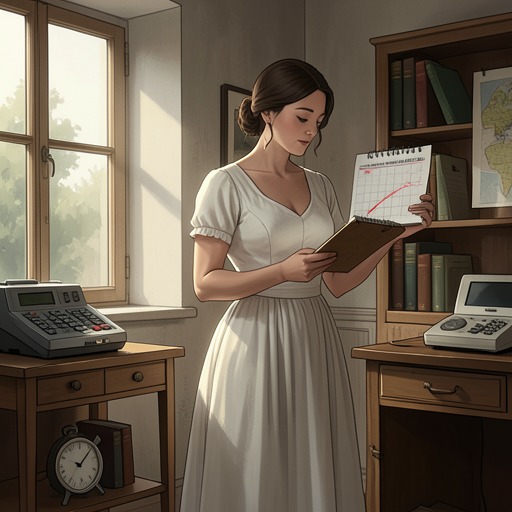
As Maori rebuilds a sense of continuity from one day to the next, she relies on a binder and journal that explain her circumstances and preserve her efforts to live as before. When she reads that she has had an accident and lost her memory, the information arrives alongside the physical fact of those records: her mother brings her cinnamon latte, her hands shake, and she turns to the binder and journal she keeps. Izumi belongs to the network of people who make these records and routines meaningful, not by erasing the disruption but by helping Maori live within it.
The different voices of the binder and journal matter. The binder organizes information for reference, while the journal is freer and more personal; Maori’s entries describe her attempt to maintain her former routine so that other people will not notice how different she feels. She is instructed to read the section about her boyfriend and the diary entries beginning on May 27. Her phone contains a matching folder, also labeled for her boyfriend, filled with photographs and videos of Tooru. Izumi’s friendship operates in this world of repeated reading and mediated introductions, where records help Maori approach relationships she cannot simply recall.
Maori’s journal also records Izumi’s attitude toward helping her. She says that she does only what she can and wants to do, and that she will stop if she no longer likes doing it. Maori takes this as reassurance that Izumi is not sacrificing herself unwillingly. The assurance allows her to acknowledge the effort friendship requires without reducing Izumi to a tireless caretaker; Izumi’s support is presented as both an act of affection and a choice she claims for herself.
Izumi is present in ordinary shared pleasures as well as moments of crisis. When Maori and Tooru ride together, Izumi accompanies them, exasperated by their yelps but also touched by the scene. Her presence places her near the relationship she once questioned. She notices that Maori becomes comfortable with Tooru more quickly over time and smiles at him more, even though Maori cannot store new memories. Izumi privately admits to feeling a little jealous. That admission gives her care an emotional complexity: she can support Maori’s growing attachment and still feel the cost of watching her closest friend move toward someone else.
Watching Maori’s Vulnerability
Izumi’s concern grows from more than the immediate effects of memory loss. She recalls a day in mid-May when Maori unexpectedly stayed home from school and did not answer messages or calls. Worried, Izumi went to the Hino family home after school; Maori’s mother stiffened when she arrived. Izumi later describes the episode as a major breakdown that she and Maori’s parents had feared might happen. The account reveals the limits of what a friend can know or control: Izumi is attentive enough to notice a sudden absence and go looking, but she encounters a distress that involves the family as well as their friendship.
Maori’s renewed drawing offers a visible change in her condition. Izumi observes that since Maori began drawing again, she has been more emotionally stable. This is not presented as a cure for amnesia, but as a meaningful improvement that Izumi can witness over time. She nevertheless thinks Tooru may be able to support Maori more than her family or Izumi can. The thought is at once generous and painful: she recognizes the particular comfort he provides while knowing that her own closeness does not make her capable of meeting every need.
Records, Secrecy, and Tooru’s Death
After Tooru’s death, Izumi confronts the consequences of deciding how much of Maori’s reality to manage on her behalf. When Maori writes about the death in her binder and diary and reads those entries the next morning, Izumi visits her before noon. Maori looks so haggard that she seems like a walking corpse. Izumi had chosen the previous day not to prevent Maori from writing about what happened. She acknowledges that the choice was wrong in her own judgment, yet also admits that she wanted to see how Maori would react when she learned that her boyfriend had died. Curiosity, a desire to know Maori’s response, and the wish to protect her pull against one another; Izumi’s care does not spare her from making a decision she later judges harshly.
The problem is not simply whether to tell Maori the fact of the death. Her binder and journals are the tools by which she learns about her own life, so changing them alters the evidence available to her. Izumi offers to type the binder and journal, or copies of them, into a computer and patch the gaps left by removing Tooru. She says she is good at that sort of work. Her offer turns friendship into a form of archival labor: she can revise the record with technical skill, but the proposed edits would also shape what Maori is able to know.
When Izumi proceeds, she gathers Maori’s binder and numerous journal volumes from a desk drawer and transfers the digital journal and notes from Tooru’s sister to Maori’s computer. The sister has also created entries for the days since Tooru’s death, and used a program to falsify the timestamps on the folders and documents. From then on, Maori will read and add to the digital versions of her notes and journal. These careful changes build a usable account of daily life, but they also show how several people, using different records and forms of access, participate in constructing the past that reaches her.
Care, Limits, and Narrative Role
Izumi’s decisions are shaped by a recurring tension: she wants Maori to be safe, yet Maori’s records and reactions cannot belong entirely to her friends. Izumi can warn a potential boyfriend, accompany the couple, reassure Maori about the effort of helping, and arrange the materials through which she learns. None of those actions makes her the sole authority over what Maori should feel or remember. Her hesitation after Tooru’s death, and her admission that she wanted to see Maori’s reaction, expose the danger of turning protection into observation or control.
Later, Maori learns that Izumi called Keiko Nishikawa. When Keiko tells her not to blame Izumi, she explains that Izumi, Tooru, and his sister had all struggled and had acted according to what they thought best for Maori. That retrospective account does not erase the consequences of their choices, but it places Izumi’s actions within a collective attempt to care for someone confronting an unbearable loss as well as an ongoing memory condition.
Through Izumi, the novel gives friendship both practical weight and moral ambiguity. She is a witness to Maori’s changing comfort with Tooru, a companion in shared activities, and a custodian of the written and digital traces that help Maori reconstruct each day. The records preserve a life, but they can also be edited, supplemented, or withheld; the person who tends them must reckon with the difference between helping someone live and deciding what that person is allowed to know. Izumi’s lasting significance lies in that unresolved responsibility, as much as in her blunt loyalty.